Spawning and encounter pressure
The director buys a group, reserves room for it, finds safe ground and brings its members in a short distance apart in time. Killing those enemies earns space: a kill does not refund their price or immediately buy replacements. For example, clearing a four-member group removes four threats; the next purchase still waits for a future scheduled opportunity.
Status: credits, composition, reservations and arrivals are implemented in opt-in fixtures (S1/S2); S2 and its elite-pack follow-up have user acceptance within that prototype. S3's passive boss and reinforcement transition are implemented with automated evidence; its gameplay acceptance remains pending. Normal production bindings remain passive. Moving assignments, squad transport and roaming-elite cooperation are planned. See checkpoint boundaries.
From credits to a living enemy
A purchase is a commitment, not a promise that every member will find ground. For example, if two members arrive and a third cannot be placed before expiry, those two stay and only the unborn member's unused price can return to the current bank.
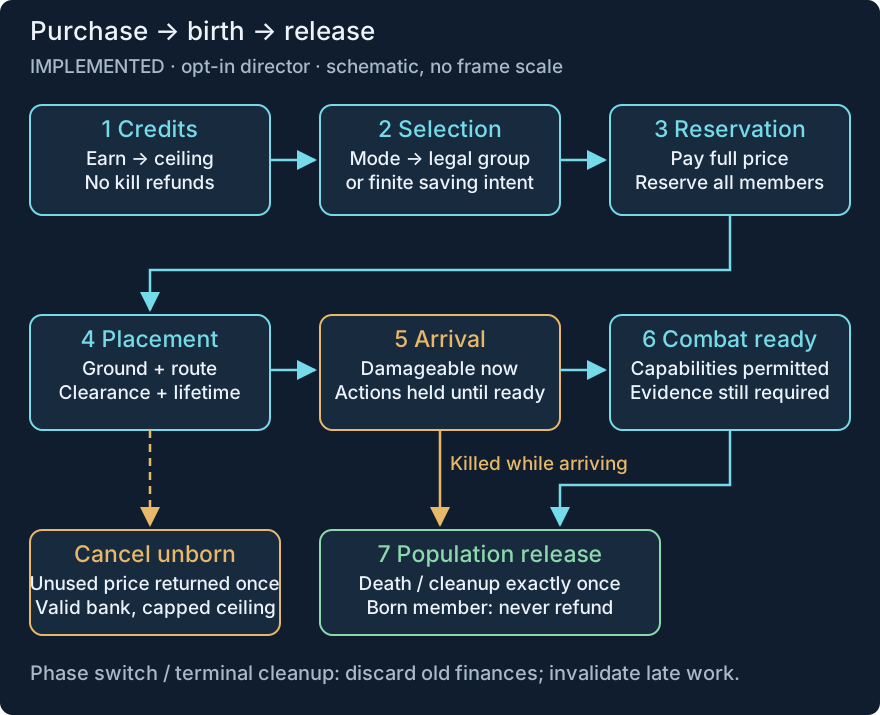
Schematic, implemented opt-in flow. Arrows show ownership transitions, not frame timing. Boss phase changes and terminal cleanup discard old finances rather than transferring refunds.
| Step | Tuning and technical detail |
|---|---|
| Earn | One authoritative bank accrues credits up to its ceiling. Income can scale with declared difficulty, stage, participant count and active run minutes. There is no hidden performance/health adaptation. |
| Choose | Choose a mode by its weight, then legal content within that mode. Price, probability and eligibility are separate. A failed selected mode has no automatic fallback to another mode. |
| Reserve | Atomically debit the complete group price and reserve every member's nonboss capacity before birth. A saving intention alone owns neither credits nor slots. |
| Place | Validate each actual member's ground, capsule clearance, native agent and route; revalidate players, occupancy and encounter/lifetime. Bounded retries never move already-born actors to a new remote footprint. |
| Arrive | Commit a verified native actor to its slot. The actor is damageable immediately; an authoritative readiness deadline holds normal movement, attack preparation/release and new support effects. Status and death continue. |
| Fight | Readiness permits capabilities to act; it grants no target knowledge and cannot turn a passive role into an implemented attack. |
| Release | Death/cleanup releases population once. Dead bodies dissolving are not living capacity. A synchronous parent-death settlement retains accounting until any legitimate child reservations settle. |
Costs, weights and group choices
A cheap enemy can be rare, and an expensive enemy can be common among affordable choices. For example, a weight of 2 versus 1 means twice the relative draw weight among otherwise eligible choices; it does not halve the credit price.
| Mode | Composition rule |
|---|---|
| Single type | One through five of one card. A selected normal card may replace at most one member using its editable singlePackEliteChance; the replacement pays the full elite price. An explicitly selected elite card can instead form an all-elite homogeneous group. |
| Premade template | An authored ordered list of card/tier identities; price is the sum of members. Required templates are rejected if invalid/oversized, rather than silently trimmed. |
| Procedural | Assemble from the active pool within group-size, cost, capacity and specialist limits. Hard exclusions are symmetric, independent of draw order. Soft positive finite multipliers adjust weights once per distinct selected triggering type. Hard exclusions win. Work is bounded, including a 65,536-node search ceiling. |
Compatibility concerns the group being assembled, not every living group. It neither deletes survivors nor bans nearby cooperation. The discussion's sniper/melee exclusion and ranged/support preference are examples, not an installed production compatibility table. Procedural rules are distinct from authored template validation. Pending and living Keeper/Lancer members also count toward their respective two-member specialist ceilings.
Elite tier and enemy role are separate. Ordinary ranged upgrades may choose same-type elite cards or an elite Bombardier only when explicitly enrolled in the active profile. Bombardier is an elite-only card; its role behavior is still pending M9. Explicit templates preserve their chosen tiers. The new mode does not also run the old kill-based elite roll.
Saving without a debt queue
The director can sometimes wait for a costly group instead of continually buying cheap enemies. For example, it can fix one 50-credit choice while holding 30 credits, accrue toward 50 and purchase it at a later normal opportunity. Becoming affordable between opportunities does not trigger a birth.
A finite saving intent captures the whole composition, cost and original expiry. The choice must cost more than the current bank, fit the ceiling and be reachable within the declared saving time/income. During saving, cheaper choices are skipped; capacity blockage spends the original saving deadline. After reservation, placement uses the separate pending lifetime. Moving players do not extend it. Expiry/invalidity cancels the intent with no substitute on that opportunity; the next future opportunity performs an ordinary affordable pass before saving again. If no valid saving candidate exists, that opportunity may use ordinary selection.
Only one pending group and one saving intent are supported. Purchase deadlines advance from now + interval, even when blocked. Pending births commit at most one member per tick, then schedule now + stagger; a delayed frame cannot drain a queue of overdue births. A capped full bank therefore permits a later expensive purchase, not a catch-up burst. Existing actors keep useful actions while admission is blocked.
Safe arrivals from any direction
Threats may arrive ahead, beside or behind the party, either visible or hidden. The readable, damageable arrival window is the defense against surprise births. For example, a rear-arriving shooter can be shot during its cue and die before it ever attacks; that death is a real kill, not a missing slot to refill.
Director purchases preserve minimum distance from every living participant, a maximum distance/useful reachable opportunity to at least one, supported ground, stage bounds, member clearance and native navigation compatibility. Verdant's baseline ring is 20–60 m horizontally with a 6 m group footprint; these are authored baseline values, not final balance. The selector has bounded candidate work (up to eight circles, 32 points each, five slots). Visibility rejection is removed in the new mode; legacy admission keeps its separate policy.
Schematic animation: three staggered arrivals — illustrative schedule, 0.4 s stagger and 1.25 s arrival window. Not gameplay capture or simulation proof.
Static fallback: A births at 0 s, B at 0.4 s, C at 0.8 s; each is damageable at birth and ready 1.25 s later. Failed placement can delay or cancel a member.
Static schedule: A ready at 1.25 s, B at 1.65 s, C at 2.05 s. This illustration assumes three successful births on schedule. Runtime safe placement and frame cadence may delay them; cues do not authorize early attacks.
Moving and split parties
The accepted design follows reachable party regions and existing committed pressure, allowing temporary imbalance. For example, a 3+1 split should influence allocation without creating four separate full population budgets or guaranteeing equal damage.
Implemented now: new purchases anchor to a living player with the lowest coarse ledger pressure, randomizing ties. Pending and living members contribute using their original birth region (paid cost / 10, descendants 1, fading with horizontal distance over 60 m). This is not tactical tracking or a moving squad assignment.
Accepted direction; C1 planned: update those commitments as groups receive temporary reachable pressure assignments; account for party size, existing approaching groups and useful role contributions. Members can move differently under a common objective. Kills remove pressure, replacement follows admission cadence, and no fixed post-clear quiet duration is promised. Reassignment must preserve health, paid recovery and bounded pursuit. Hidden retirement is separate M7 work; visible birth permission does not permit visible disappearance or teleport recovery.
Exploration becomes the boss encounter
Boss entry replaces the spawning stream while keeping the fight's survivors. For example, if ten ordinary actors survive and the boss add limit is six, those ten remain and prevent reinforcements until enough die; they are not deleted to fit the new limit.
At 40 eligible kills, S3 retires exploration scheduling, cancels its unborn commitments/saving and discards its bank. Living actors retain identity, health, status, arrival deadlines and paid actions. One safely placed passive boss uses a trusted singleton reservation outside the nonboss count. Boss placement retries accrue no reinforcement income. Only successful live boss birth activates the separate profile, grants its initial balance once and sets its first future purchase opportunity.
Boss income, bank ceiling, interval, pool/mode weights, saving controls and nonboss add limit are independent. Reinforcement deaths retain applicable rewards but neither refund credits nor complete the stage. Boss defeat closes pending work and hostile effects, invalidates admission generations and clears surviving nonboss actors nonlethally, without kill/loot credit, before checkpoint progression. Reset, stage/session end and terminal defeat also invalidate late births/readiness. Boss attacks and blocked-boss recovery remain separate M14/level work; no automatic deletion or free defeat is authorized.
Population exceptions: latest accepted amendment
Capacity limits director purchases, with two narrowly trusted exceptions. For example, a legitimate parent death may produce two children above the limit; those children then count and block further purchases.
| Origin | Counting and cancellation |
|---|---|
| Purchased nonboss, including boss reinforcements | All living plus pending nonboss count once; admission limit at most 16, independently lower per profile. No cap bypass. |
| Singleton encounter boss | Admitted independently of nonboss population; stays outside that count. Safe physical placement/readiness still apply. |
| Legitimate Splinterbeast children | At most two local nonrecursive children; release/settle parent and valid child reservations atomically. They may exceed the limit but count immediately. Overflow cancels unborn paid members and refunds only their unused cost once into a still-valid bank, capped at its ceiling. No cross-generation refund. |
The child identity/accounting contract exists in the ledger; actual splitting/local child placement is still M13 work. The accepted future placement policy makes bounded immediate nearby attempts, omits failures and keeps no backlog. Children use the death location, boss entry its authored region; neither uses the ordinary ring, and neither bypasses collision, stage or lifetime checks.
There is no universal 17-actor ceiling in this amended direction. This supersedes the research's earlier shared hard-cap statement and old child-cap restriction. Cap reductions retain living survivors. Placement timeout/ordinary cancellation returns only unborn paid slots; killed or already-born members never refund. Profile switches/terminal closure discard old finances and do not transfer refunds to a new generation.
Current fixture tuning
These values describe inspected assets, not accepted balance. For example, the boss fixture currently allows 12 nonboss adds, even though the S3 starting proposal and older brief mention six.
| Captured field | S2 arrival exploration | S3 exploration | S3 boss adds |
|---|---|---|---|
| Base income (credits/s) | 4.5 | 4.5 | 3 |
| Bank ceiling / initial (credits) | 100 / 5 | 100 / 5 | 60 / 0 |
| Purchase interval (s) | 6 | 6 | 8 |
| Nonboss admission limit | 16 | 16 | 12 (dirty user tuning) |
| Saving probability / lifetime (s) | 0.25 / 12 | 0.25 / 12 | 0.25 / 12 |
| Single / template / procedural mode weights | 1 / 0 / 0 | 1 / 0 / 0 | 1 / 1 / 1 |
Member stagger 0.4 s, pending lifetime 20 s and arrival window 1.25 s are common here. The separate S1 passive-roster profile is not the S2 shooter pool. Do not substitute the plan's initial 10 credits/s, 20 initial credits or four-second interval for current authoring. Income uses base × difficulty × (1 + 0.4 × (participants − 1)) × min(4, 1.15^min(11, stage − 1)) × min(3, 1 + 0.04 × activeRunMinutes) with finite-input validation. Existing health/damage scaling is separate. Restart the director to capture edits; do not infer live retuning.
The inspected S2 normal shooter costs 10 credits at weight 1; its elite costs 30 at weight 0.25, with normal-card upgrade chance 0.25. Templates may exist while their mode weight is zero: the custom ranged-elite template is present but template draws are disabled in current S2 exploration. S1 passive exploration weights are 1 / 1 / 0; its boss profile uses 1 / 1 / 1. These are provisional authoring choices, not missing composition support.
Source and decision trail
Read inspection identity before attributing proof to this working tree. Latest accepted amendments outrank early research proposals; source/assets determine what runs.
- Decisions and bounded saving/population contracts: companion plan, earlier research.
- Choices and finance: definition, rules, group selection, scheduler.
- Accounting and phase ownership: ledger, credit integration, boss integration.
- Physical placement and readiness: selector, placement rules, arrival state, presentation.
- Current authoring: S2 profile, S3 profile, S1 passive profile.