Engagement phases and live diagnostics
An enemy has a limited opportunity to pursue, can keep fighting while it makes a real contribution, and must interrupt pursuit when that opportunity expires. Each enemy owns its cycle independently, including members of the same birth group. Breaking sight should buy useful space without making a nearby enemy harmless.
Implemented in opt-in checkpoints, 23 October 2026: finite engagement replaces pursuit credits, gradual renewal and fixed combat-area restrictions. The baseline is 20 s pursuit / 2 s consecutive bolt contribution / 3 s Breakoff. A newly admitted valid melee attack confirms combat immediately, including a later miss. Tasks 1–2 have user-reported playtesting acceptance; overhead visuals are accepted. Moving diagnostic readability and the integrated keep/tune/revert decision remain open. Qualification and acceptance have their own scope; normal production bindings remain passive.
The four phases
| Letter | Phase | What it means |
|---|---|---|
| A | Available | Eligible for assessment. No current pursuit deadline; a useful admitted attempt starts Pursue. Waiting does not promise a new route. |
| P | Pursue | Approach, direct pursuit or personal-evidence search inside one original finite attempt. Legal attacks can occur before Fight is confirmed. |
| F | Fight | Actual combat contribution is confirmed. No finite Fight countdown. Losing the viable contribution starts a new finite pursuit attempt. |
| B | Breakoff | Full mandatory interruption of new target-seeking movement. Independently legal attacks remain possible; confirmation cannot restore travel early. |
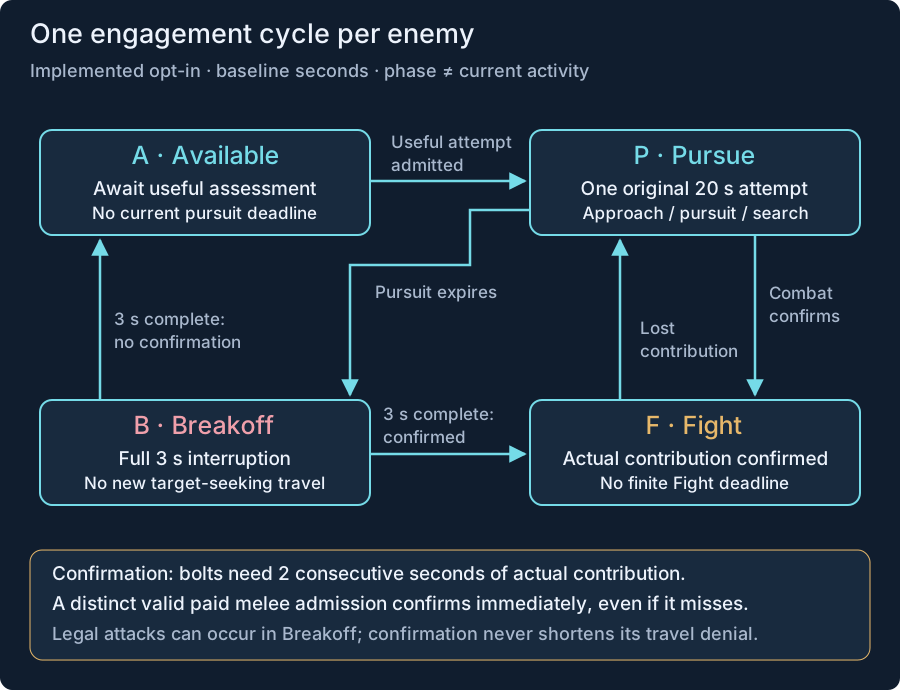
Implemented opt-in flow, with captured baseline seconds. Arrows show owner transitions, not guaranteed frame timing. Legal combat can also confirm directly from Available without pursuit admission. Every route and attack still needs its own valid evidence, physical safety, authority and lifetime.
For bolts, confirmation needs two consecutive seconds of legitimate attack-owner contribution, rather than two seconds of seeing a target or receiving damage. Interrupted contact cannot accumulate into confirmation. For melee, each distinct valid paid admission counts immediately; a dodged attack remains a real attempt. Proximity, repeated graph ticks, failed requests and incoming damage do not count. An old cooldown after the target leaves cannot sustain Fight indefinitely.
Expiry wins at the pursuit boundary. The owner starts a full Breakoff when it observes expiry, even after a stall; it cannot catch up through an unseen break. Combat can become confirmed during Breakoff, but movement remains denied until the full interval ends. Otherwise the actor returns to Available for assessment. The normal 2 s reassessment cadence is not a guaranteed restart timer.
Watch a failed pursuit
Schematic animation: confirmed Fight → escape → Breakoff — 2× playback; assumed loss of contribution at scenario time 3 s. No movement, sensing or combat is simulated.
- F · confirmed Fight
- P · original 20 s attempt
- B · full 3 s interruption
- A · awaiting assessment
Static example: Fight has no deadline.
Static fallback: at 3 s the player escapes and Pursue ends at 23 s. A brief peek/report at 10 s does not move that deadline. Breakoff lasts from 23–26 s, then Available awaits assessment. This example has no confirming combat after escape.
The example chooses its events for explanation. A real actor may confirm combat, stop searching early, have no legal route, or remain unavailable for other reasons. Repeated retreat/reassessment must still be judged in human playtesting: periodic enemy trains or synchronized disengagement are not accepted merely because the individual timers are correct.
What a new sighting changes
Fresh personal sight can update the captured eye, movement estimate, wall rays and predictions. It cannot extend the current pursuit deadline or refund spent search travel, attempts or inspections. Switching target, importing a report, taking a hit, graph reentry, root/stun, yielding and deferred queries cannot refill them. Only a genuinely new admitted attempt receives a new bounded search allowance.
Search and pursuit have different deadlines. An Ordinary search can finish before its enclosing 20 s pursuit attempt. The search allowance is shared across targets within that attempt; another target is not another free budget. See search clocks and stopping.
Movement permissions capture their original actor, target, run, stage, evidence, cycle/assignment and expiry. An old accepted route cannot resume after those lifetimes change. Removing the old combat sphere preserves coarse pressure regions, the 60 m physical route ceiling, 4 m local footprint, supported ground, capsule clearance, route validation, destination claims and one voluntary movement writer.
Read the label above an enemy
Enable Camera-facing enemy labels (opt-in sandbox). Labels project above each live fixture enemy into the local player's camera; they do not rotate the enemy. The phase letter and activity code are independent. For example, P | SH means shooting during an unconfirmed pursuit, and B | SH can mean legal stationary fire during Breakoff. F | RC can show paid recovery without a Fight deadline.
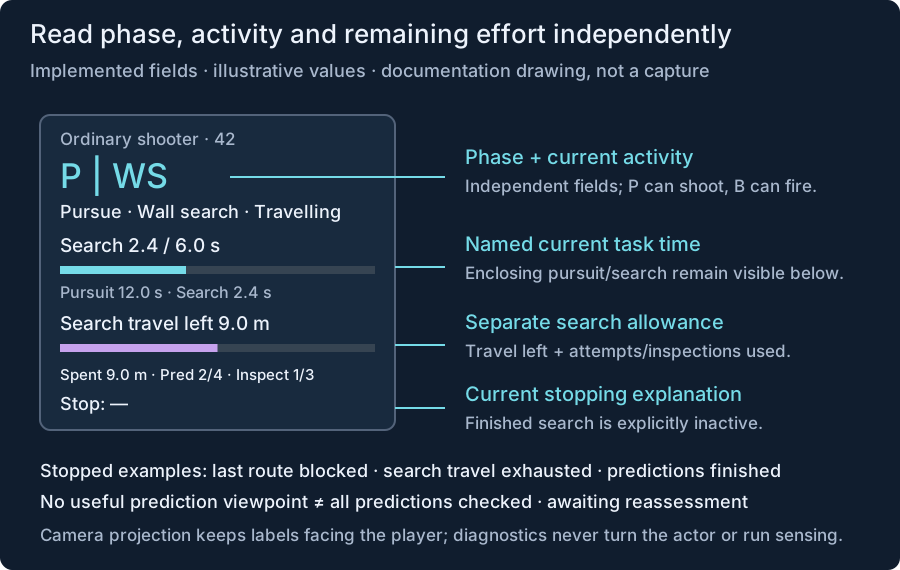
Documentation drawing of the implemented fields, with illustrative values. This is not a gameplay capture or a moving-readability acceptance result.
| Code | Current activity |
|---|---|
| H | Holding / no active task |
| PA / DP | Pressure approach / direct pursuit |
| WS / PS | Wall-derived search / other prediction search, including planning, travel or inspection |
| SH / ME | Shooting / melee preparation, commitment or lunge as labelled |
| RC | Paid attack recovery, when movement/search is not the current activity |
| OB | Observing captured evidence |
| AR / RG / RA | Bounded ally clearance / allied regroup / recovery approach |
The first bar names the current bounded task: a move, search, observation, shot phase, melee phase, paid cooldown or Breakoff. A short shot bar is not the pursuit timer. The separate line retains enclosing pursuit/Breakoff and search countdowns when relevant. Fight has no invented deadline; Available has no invented reassessment countdown. Attack activity takes display priority over concurrent work.
The second bar shows search travel remaining, with metres spent, admitted
viewpoint attempts used/maximum (labelled Pred) and inspections used/maximum.
Pred is not a count of generated hiding-place markers. Wall and other prediction
search share the same allowance. A finished allowance is labelled Last search ·
inactive; remaining metres alone do not mean it can still be spent.
The bottom Stop line distinguishes pursuit expiry, blocked last route, search
travel/attempt/inspection exhaustion, search deadline/evidence expiry, finished
predictions, no useful supported viewpoint, paid recovery and awaiting reassessment.
Predictions finished requires actually checked predictions; No useful prediction
viewpoint does not claim the area is cleared. Historical search/route outcomes in
the text inspector remain labelled history. Active work displays a dash.
Reading diagnostics never advances owners, performs perception/geometry queries, consumes RNG, reserves claims or alters deadlines/budgets. These controls are opt-in and excluded from release builds. Human readability checks still cover moving cameras, crowds, distance, timing and cost.
Exercises and tuning
Open ProjectI > Debug > Enemy AI > Shooter sandbox, select Engagement exercise (next reset) and launch Engagement C1 normal, C1 large elite or C2 pack + elite. E06's individual launch uses the paid melee fixture. Quick entries also exist under ProjectI > Enemy behavior > Engagement checkpoint. F5 recreates the chosen fixture with fresh identities and captures tuning; Stop restores Editor scenes.
| Exercises | What to inspect |
|---|---|
| E01–E04 | Moving combat, supported detours, cover exit, fresh evidence without refills |
| E05–E08 | Consecutive bolt confirmation, distinct melee admissions, paid long cycles, full Breakoff |
| E09–E10 | Repeated cycles, independent actors and split/swapped targets |
| E11–E13 | Interrupted work, ally clearance, death/reset/disconnect/stage cleanup |
The settings reference records all exercise names and controls. A fixture launch supplies instructions, not a pass. Two/four-peer human observations require independently controlled players; a C2 pack is not a peer.
Source: cycle, owner integration and immutable receipts, movement context, inspection mapping, overhead rendering, replacement plan.